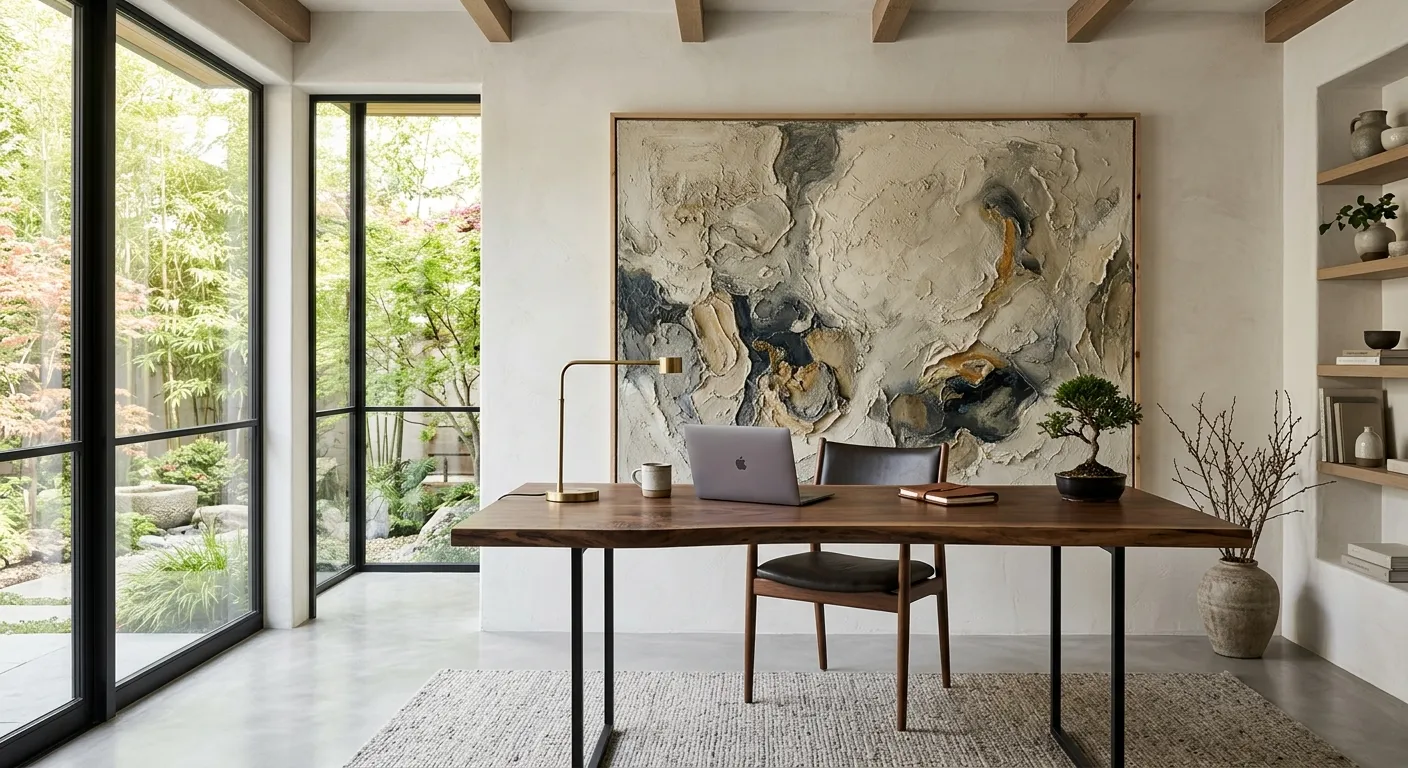
Your pupils dilate roughly 400 times a day trying to adjust to the refresh rate of your monitor and the harsh glare of your "minimalist" white desk. That throbbing behind your eyes at 3 PM isn't burnout. It's biological rejection.
Focus & Flow
The Visual Silence of Wabi-Sabi Offices
The "Clean Desk" Lie
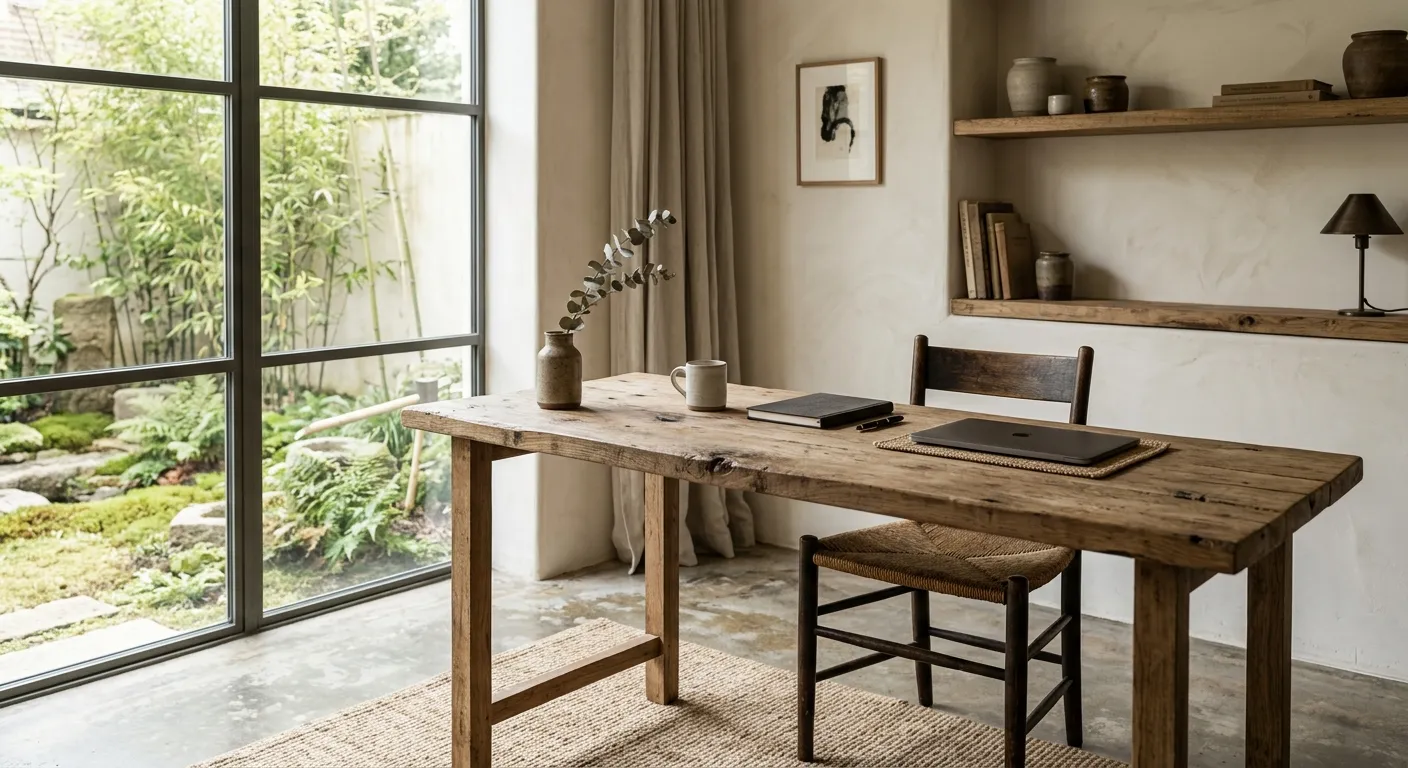
The industry sold you "minimalism" as a cure for chaos. They lied. High-gloss white surfaces (reflectance value >80%) act as visual mirrors, bouncing every stray photon directly into your retinas.
This creates stroboscopic stress—a low-grade, invisible flickering that forces your visual cortex to burn glucose just to maintain a stable image. True Visual Silence isn't emptiness; it's absorption.
Interactive Experiment A:
"Use the simulator to test your visual cortex response to surface reflectance. Observe how matte, organic surfaces reduce the neuro-chemical load."
Photon Bounce Simulator
i.
Clinical Report: The Neurobiology of "Ugly" Surfaces (Read Analysis)
▼
1. The Photon Bounce Effect
When we discuss "Visual Silence," we are fundamentally discussing Light Reflectance Value (LRV). The minimalist trend of 2020-2025 favored white, glossy surfaces with LRVs approaching 90%. In a brightly lit home office, this creates a secondary light source. Your monitor emits light; your desk reflects it. Your eyes are caught in a crossfire.
The iris muscle constricts to handle the glare, but the monitor requires dilation to perceive contrast. This oscillation (pupillary hippus) happens thousands of times an hour. By 2 PM, the ciliary muscles are exhausted. This is why you get headaches. Wabi-Sabi materials—matte wood, clay, unpolished stone—have LRVs between 15% and 30%. They absorb photons. They are "dark matter" for your visual field.
2. The "Touch Hunger" Hypothesis
Humans are somatosensory creatures. Our fingertips are densely packed with mechanoreceptors. When you spend 10 hours a day touching smooth glass (phones) and smooth plastic (keys), you starve the somatosensory cortex. This leads to a phenomenon known as "Sensory Gating Failure."
The brain, starved of physical texture, begins to amplify other signals—specifically, anxiety and background noise. Introducing a "High Friction" element—a raw wood desk edge, a rough ceramic mug—provides a "Grounding Signal." It confirms physical reality. It interrupts the anxiety loop.
Anatomy of a Faraday Cage
We aren't building a "cute office." We are building a bunker for your attention span. Every element here is a tool for reducing signal interference.
Material Dopamine Lab
Select a material to simulate the somatosensory cortex response signal.
Tactile Data
Hover over or click the elements in the diagram to reveal the physiological specification and installation notes.
The Metabolic Cost of Ugly
We modeled the Cortisol Drift in two environments. The results aren't just about "feeling good." They are about how much glucose your prefrontal cortex has left at 4 PM.
Cortisol Accumulation Drift
Simulated cognitive load over an 8-hour workday.
Optimal Sensory Diet
The ideal balance of texture, light, and silence.
Entropy Wiper
Execute the Amputation Protocol. Click the chaotic elements below to eliminate visual noise.
Visual Silence Achieved
The Void is Complete
The Manifesto: 6 Commandments
I. Friction over Flow
The modern world sells you "seamlessness." It tells you that everything should be within reach, that voice assistants should do your bidding, that your chair should pivot with zero resistance. Reject this. Seamlessness is the enemy of mindfulness. When everything is easy, your brain enters "Automatic Mode." Design physical obstacles to your bad habits.
II. The 50% Void Rule
Look at your desk. If your visual field is more than 50% filled with objects, you are in a cognitively expensive environment. Empty space is not wasted; it is the cooling system for your neural engine. Defend your empty space with the same aggression you defend your bank account.
III. Patina is Data
Plastic dies; wood ages. A scratch on plastic is trash. A scratch on oiled walnut is a record of time. Surround yourself with materials that handle the timeline of your career with dignity.
IV. Light Temperature is a Drug
Lighting is not about visibility; it is about endocrinology. Blue light (4000K+) tells your adrenal glands a tiger is chasing you. Warm light (2700K) tells them the fire is lit and you are safe. Stop overdosing on blue light.
V. Cable Management is Plumbing
You don't want to see your toilet pipes. Why do you want to see your HDMI cables? If you can see a wire, the design has failed. Wires represent entropy. Buried is better than bundled.
VI. The Biophilic Imperative
One plant is decoration. Three plants are an ecosystem. We evolved in complex green environments. Stark geometric lines are stressful. Plants act as visual palette cleansers.
Focus & Flow
Part of the Zen Home 2026
Strategic Outlook
Designing for Biological Reality
Scientific References
-
[1]
Saxbe, D. E., & Repetti, R. (2010). "No Place Like Home: Home Tours Correlate with Daily Patterns of Mood and Cortisol." (PubMed)
Evidence: Confirms the "Entropy Wiper" premise—visual clutter in the home environment is directly linked to flattened diurnal cortisol slopes and chronic stress.
-
[2]
Kaplan, S. (1995). "The Restorative Benefits of Nature: Toward an Integrative Framework." (Journal of Environmental Psychology)
Foundation: Supports the "Biophilic Imperative" and "50% Void Rule." Attention Restoration Theory argues that "soft fascination" (nature, empty space) restores depleted cognitive resources.
-
[3]
Ikei, H., et al. (2017). "Physiological Effects of Touching Wood with the Palm of the Hand." (J. Physiol. Anthropol. / NIH)
Validation: Supports the "Material Dopamine Lab." Touching uncoated wood significantly decreases systolic blood pressure compared to touching artificial materials like marble or stainless steel.
-
[4]
Lockley, S. W., et al. (2003). "High Sensitivity of the Human Circadian Melatonin Rhythm to Resetting by Short Wavelength Light." (PubMed)
Mechanism: Scientific backing for "Light Temperature is a Drug." Blue light (460nm) suppresses melatonin twice as much as green light, disrupting the recovery phase essential for deep work.