Dimmable Warm Lighting: When It Helps and What to Check First
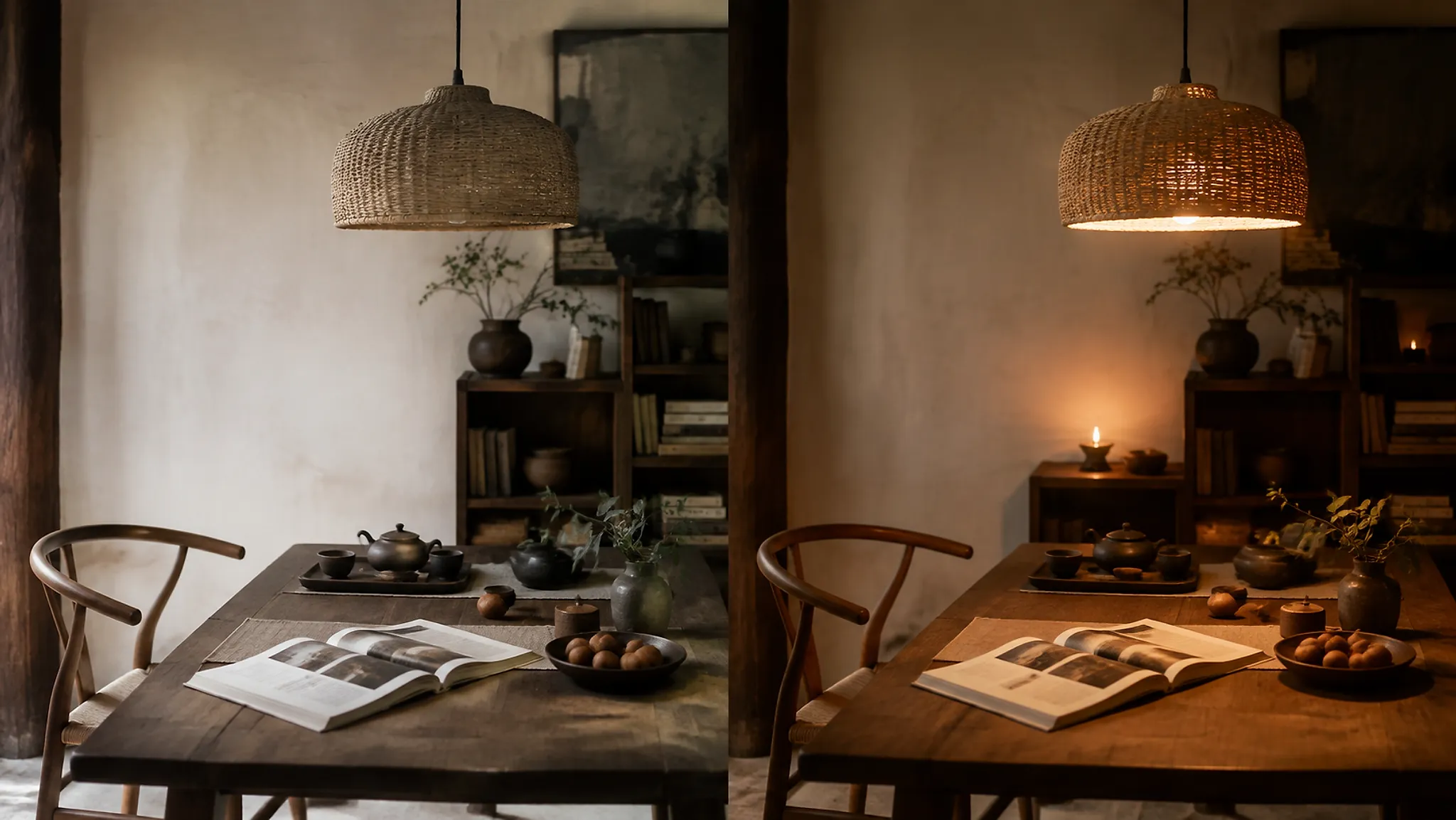
A woven shade, pale plaster wall, or dark timber shelf can take on a softer appearance under low warm light. The practical question is whether the room needs more than one light level, and whether the lamp, fixture, dimmer, and connected load will work together.
Dimmable warm lighting is useful when the same room shifts between brighter tasks and lower-light use, such as reading and conversation, cooking and dining, or setting and clearing a table.
It adds less value when one steady level already serves the room, or when the existing fixture and control cannot provide stable adjustment. Before buying, identify the lamp or integrated fixture, the exact dimmer model, the connected load, and any enclosure restrictions. A “dimmable” label does not establish compatibility by itself. Treat warmth as a visual preference; verify the hardware separately.
broader context
Broader context
Use the broader page when you need more context before this narrower page.
When Adjustable Warm Light Is Useful
Dimming earns its place when the required light level changes while the room stays the same. A living-room lamp might need enough output for reading, then a lower setting when attention moves to conversation or tea. A dining pendant can provide stronger light for setting the table and a quieter visual level during the meal.
The room still needs enough light for its actual work. Deeply dimmed warm light may bring out timber, paper, clay, and woven textiles, yet leave fine print, food preparation, cleaning, or color comparison difficult to see. Where tasks are demanding, keep a suitable task light instead of asking one ambient source to cover every use.
Look beyond the number printed on the package. A dark shade absorbs more light than a pale translucent one; a narrow beam can leave nearby surfaces dim; glossy finishes may show sharp reflections even at moderate output. Daylight changes the balance too. A lamp that looks warm and even after sunset may appear weak or overly yellow beside an afternoon window.
Dimming provides a range, not a guaranteed atmosphere. The useful range runs from the brightest level the room needs to the lowest level you would actually use.
Warm White and Dim-to-Warm Are Not the Same
Product labels often fold several lighting features into one impression. They describe different controls:
Dimmable warm-white lamp
Brightness can be adjusted, while the color appearance may remain broadly similar.
Dim-to-warm lamp or fixture
The light is designed to shift toward a warmer appearance as its output decreases.
Tunable-white product
Color appearance can be adjusted, often separately from brightness, when the control system supports it.
None of these category labels tells you how smoothly or deeply a particular product will dim, or whether it will hum, flicker, drop out, or remain stable with your control. A 2020 dim-to-warm stress-testing report found variation among the selected products it examined; it did not establish one performance rule for the entire category. For a purchase, exact product documentation matters more than the broad label.
Kelvin and lumens answer different questions. Kelvin describes nominal color appearance, with lower values generally indicating warmer-looking light. Lumens describe light output. Neither figure explains how a shade, reflector, recessed housing, or beam pattern will distribute that light in the room.
DOE guidance on establishing LED equivalency recommends considering output, distribution, physical form, dimming behavior, compatibility, and sensitivity to heat in enclosed spaces rather than relying on watt-equivalent wording alone. Warmth may be what you notice first; output, fit, and operating conditions decide whether the product belongs in the fixture.
What to Check Before Buying
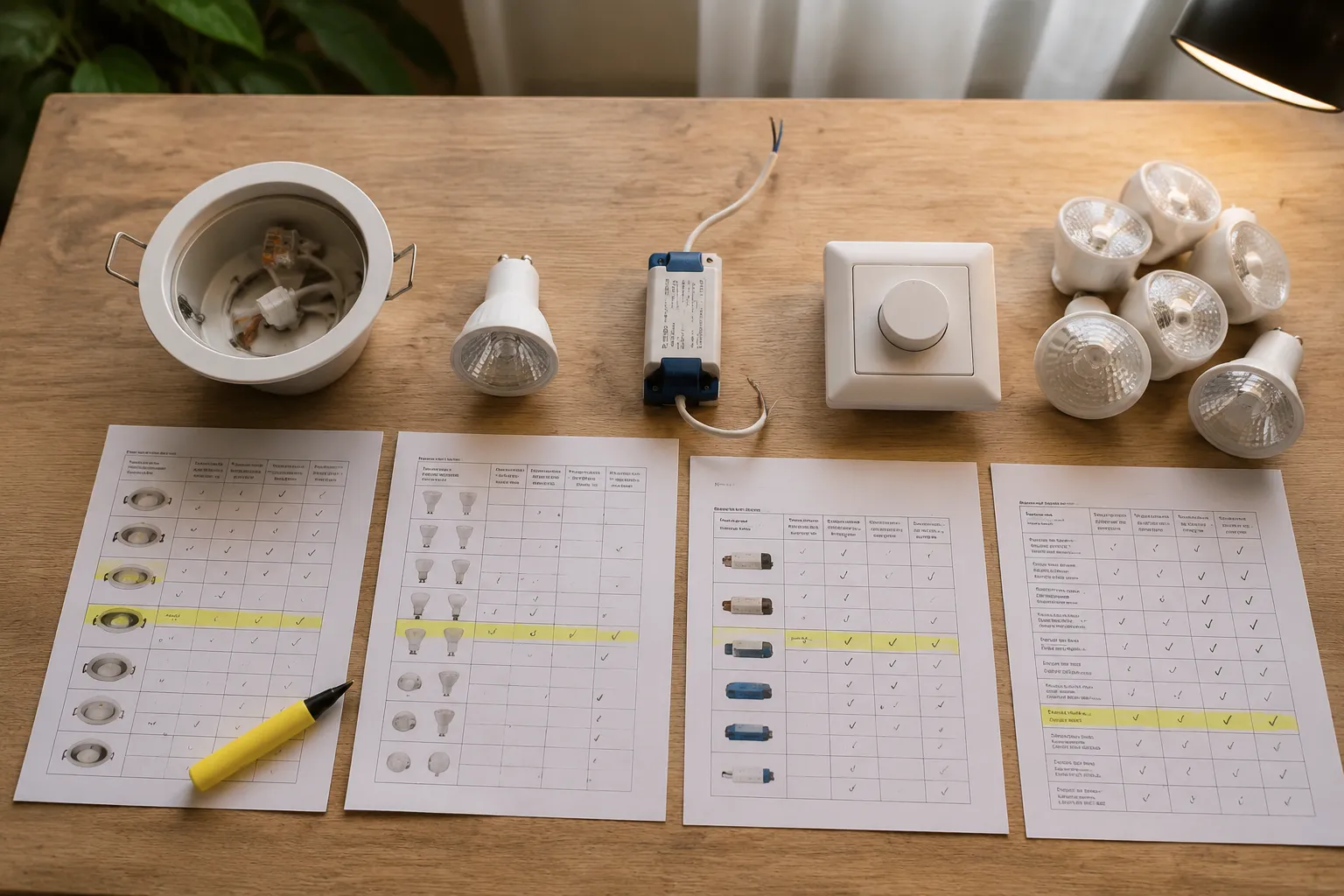
Start with the room and work toward the electrical components. This keeps an attractive bulb or fixture from deciding the setup before its constraints are known.
| Check | What to record | Why it matters |
|---|---|---|
| Room task range | Brightest required task and lowest useful level | Shows whether adjustment adds useful flexibility |
| Light source | Replaceable bulb or integrated LED fixture | Determines whether the lamp can be changed independently |
| Product specification | Dimmable status, lumens, nominal Kelvin value, dimensions, base, and distribution | Confirms basic output, appearance, and physical fit |
| Existing control | Dimmer type, manufacturer, and exact model number | Performance can depend on the specific source-and-control pairing |
| Connected load | Number of lamps and their documented electrical load | The control must suit the installed group, not an old wattage assumption |
| Fixture conditions | Open or enclosed fitting, transformer or driver, ventilation, and insulation contact where relevant | Heat and accessory components can restrict product choice |
| Documentation | Current compatibility chart and installation instructions for the exact models | Brand-level or product-family claims may be too broad |
A 2013 PNNL report on LEDs used with phase-cut dimmers describes a basic source of incompatibility: many phase-cut controls were designed around incandescent loads, while LED drivers can behave differently. The report is too old to serve as current installation guidance, but its central buying check remains useful. Confirm the particular LED source and dimmer together.
Replacing incandescent bulbs with lower-wattage LEDs also changes the connected load. The available sources do not establish a universal minimum load or low-end setting for all products. Use the dimmer maker’s documented load range and the lamp or fixture maker’s current compatibility information. Match exact model numbers where possible; a similar product name is not enough.
Read enclosure language with the same care. A bulb may fit physically but still be excluded from a closed shade or sealed fixture by its instructions. With an integrated fixture, the light source, driver, housing, and control operate as one system. Record the complete fixture model before changing its wall control.
Test the Exact Combination in the Room
Where return terms and project conditions allow, test one lamp or a small quantity before replacing every source. A 2014 PNNL study of 14 LED A-lamps and four dimmers found differences in dimming curves, low-end behavior, and flicker characteristics across the combinations tested. Its sample was limited and the product market has changed, so the measured results should not be treated as thresholds for current models. The useful lesson is narrower: products carrying the same broad label may behave differently.
Test the range the room will actually use
- 1. Turn the light on at full output and let it operate normally.
- 2. Move through several intermediate settings, pausing at each one.
- 3. Lower it to the dimmest level that remains useful in the room.
- 4. Raise it again and note whether the response is consistent.
- 5. Repeat with all intended lamps installed, because a group may behave differently from one lamp.
Watch and listen
Check for flicker, hum, delayed starting, abrupt brightness jumps, dropout, unstable output, uneven dimming, or individual lamps switching off.
Inspect the room
Look at a book page, tabletop, wall art, timber grain, ceramics, and walking paths. A combination can function electrically while still producing the wrong beam shape, too little full output, or an unusable low setting.
A historical PNNL residential downlight demonstration provides one limited example. Investigators observed uneven or truncated dimming, flicker, and individual units switching off in an installation using a control absent from the manufacturer’s compatibility list. The builder later reported satisfactory operation with a recommended dimmer. This was one older installation, not a prediction for current products, but it illustrates why model-level checking should precede a room-wide purchase.
The Smallest Dependable Decision
Choose dimmable warm lighting when the room genuinely needs more than one light level and a warm appearance suits its surfaces and use. Then verify the complete chain: task range, source type, output, color appearance, physical fit, enclosure conditions, dimmer model, connected load, and current installation documents.
The available technical material identifies common compatibility questions, but it is older and concentrated in DOE and national-laboratory reports. It does not provide universal limits for color temperature, minimum load, low-end output, enclosure suitability, or flicker, and it cannot predict whether two current models will work well together.
Begin with one fixture and one exact combination. The room will show whether the range is useful; the documentation will show whether the components are intended to work together.