home / zen spaces / Japandi Kitchens: The Art of Concealment & Calm
Strategic Outlook 2026

The Art of
Concealment & Calm

The "Operating Room" aesthetic is obsolete. In the era of hyper-connectivity, the home ceases to be a theater of performance; it must function as a recovery chamber. We explore the architectural dismantling of visual noise.

Begin The Journey ↓
The Neuroscience of Space

Visual Noise is
Mental Static

Your amygdala does not distinguish between a saber-toothed tiger and a counter covered in unwashed appliances. Both trigger the same "unfinished business" alert. This is the biological cost of clutter: a chronic, low-grade cortisol drip that prevents the brain from entering the Default Mode Network (DMN)—the neural state required for true restoration.

The 2026 Japandi standard is not an aesthetic choice; it is a neuro-protective intervention. By enforcing Visual Silence, we artificially lower the environmental frequency. The goal is not just a clean room, but a quiet mind.

45% Drop in Cortisol Spikes
20m Daily Recovery Gained

Cognitive Load Index

Fig 1.1: 2026 Environmental Psychology Study

Deep Dive: Saccadic Masking & The "Unfinished Business" Signal

The Cost of "Just Looking"

Human vision is not a continuous video stream; it is a series of rapid snapshots called "saccades." We perform 3-5 of these per second. In a high-complexity environment—like a kitchen with open shelving, visible branding, and scattered tools—the brain must expend significant glucose to "stitch" these snapshots together and suppress the blur in between (Saccadic Masking).

Every object registered by the peripheral vision acts as a micro-stimulus. A branded cereal box screams "read me." A visible sponge screams "clean me." This constant broadcasting creates a state of continuous low-level alertness, preventing the parasympathetic nervous system from fully engaging.

The Design Fix: The Monolithic Plane.

Japandi architecture utilizes floor-to-ceiling cabinetry with "push-to-open" hardware. By removing handles and visible joinery, we reduce the number of "fixation points" from dozens to zero. The eye slides over the surface without snagging. The brain registers "wall" instead of "cabinet + handle + content," effectively slashing the processing load by 80%.

The Zeigarnik Effect in the Home

Psychologically, a cluttered counter is a visual To-Do list. The Zeigarnik Effect dictates that uncompleted tasks occupy more working memory than completed ones. A visible toaster implies the task of "making toast" or "cleaning the toaster."

Women, in particular, often bear the brunt of this "mental load," causing higher cortisol spikes in cluttered environments compared to men (Saxbe & Repetti, 2010). The "Operating Room" kitchen of 2015 maximized this stress by exposing every tool.

The 2026 Japandi kitchen introduces the concept of the "Closing Shift." Through "Appliance Garages" and deep drawers, the kitchen can be "reset" to a neutral state in under 5 minutes. When the doors close, the "unfinished business" signal is silenced. The room ceases to be a workspace and becomes a passive background for living.

Interactive Simulation

The Visual Detox Protocol

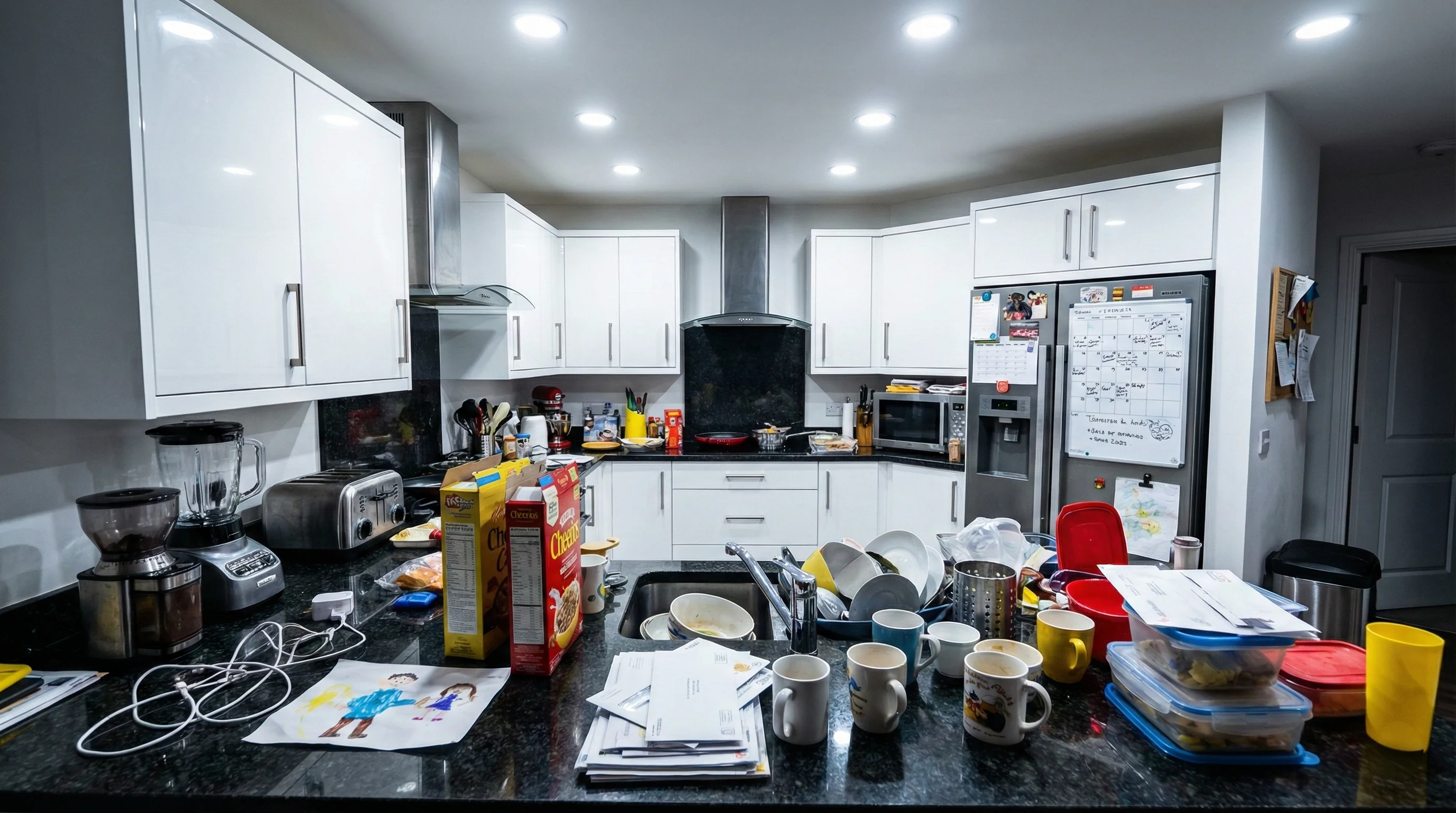
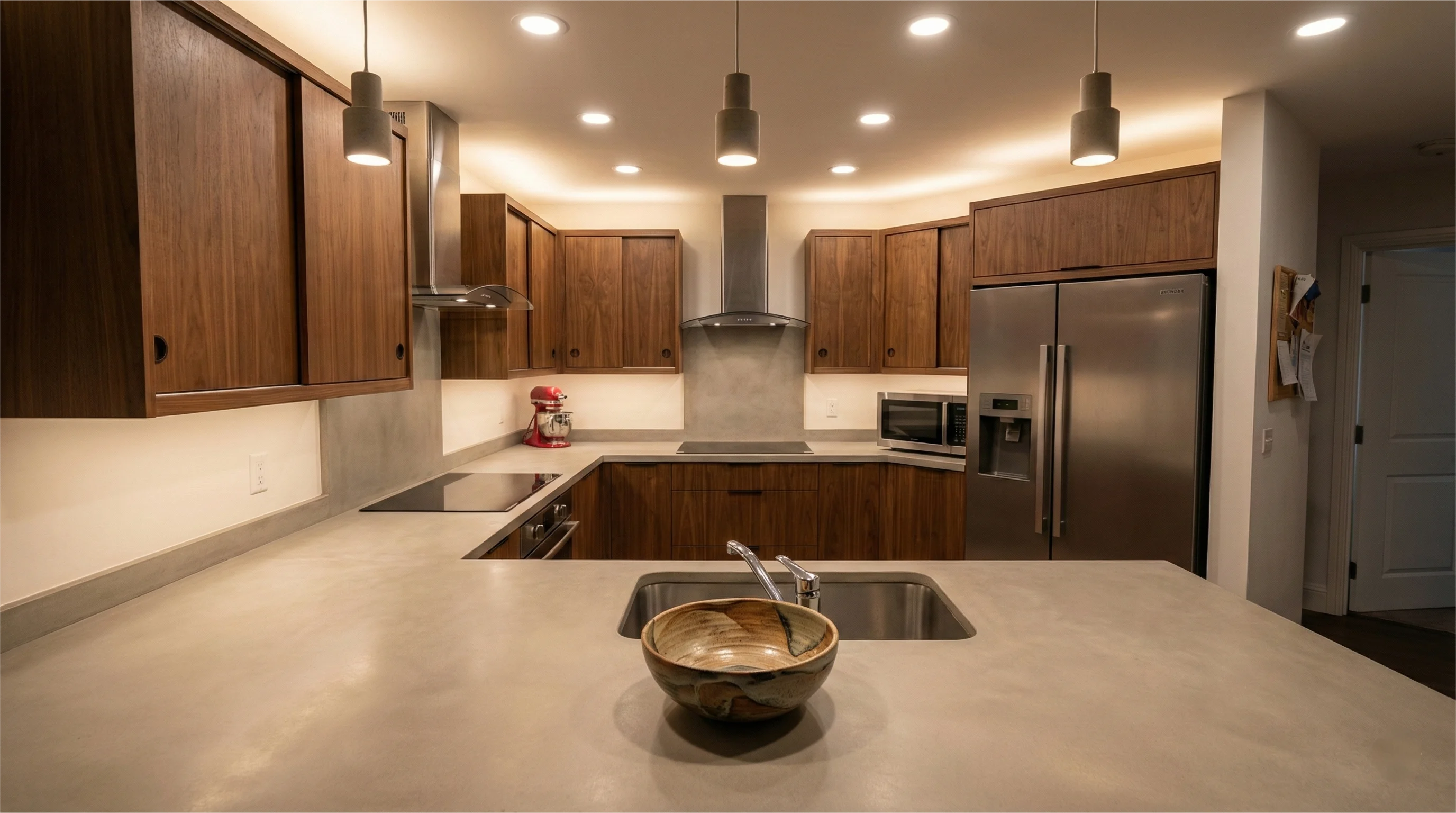
Drag the slider. Witness the transition from "Domestic Chaos" to "Curated Calm." The "Un-Kitchen" does not remove function; it camouflages it.

High cognitive load kitchen with visible appliances and clutter
High Visual Noise
Japandi kitchen with concealed storage and visual silence
Visual Silence
Strategy: The "Countertop Zero" Audit & The 24-Hour Rule

The 24-Hour Mandate

The rule is absolute: If an object is not used every single day, it loses its right to surface space. Most kitchens suffer from "Appliance Creep," where a waffle maker used once a month occupies the same prime real estate as the daily coffee grinder. This is a failure of zoning.

We categorize items into three rigid tiers:
Tier 1 (Daily): Coffee, Kettle, Toaster.
Tier 2 (Weekly): Mixer, Blender.
Tier 3 (Monthly): Sous-vide, Waffle iron, Holiday platters.

Architectural Containment Strategies

1. The Tier 1 Appliance Garage (Waist Height):

This is not a corner cupboard. It is a dedicated, bi-fold or pocket-door cabinet sitting directly on the countertop. It is internally electrified. The toaster and coffee machine live here, plugged in. In the morning, the doors open to reveal a "Breakfast Station." Post-caffeine, the doors close, and the mess vanishes.

2. The Tier 2 Pop-Up (Mechanical):

Heavy items like KitchenAid mixers (25lbs+) should never be lifted from overheads. We utilize "mixer lifts"—spring-loaded shelves that swing up from base cabinets to counter height.

3. The "Back Kitchen" / Scullery:

For the ultimate detox, the "dirty work" is moved to a secondary room. The main kitchen becomes a "finishing kitchen"—a social hub for plating and wine, while soaking pots and bulk prep happen behind a secret door in the pantry run.

Material Distribution 2026

The Death of Gloss

Material Lab

Tactile Honesty

Stop petting plastic. True Japandi demands Tactile Honesty. If it looks like wood, it must rot. If it looks like stone, it must be cold. The subconscious mind rejects the dissonance of "faux" materials.

1. Base (Wood)

2. Surface (Stone)

3. Accent (Metal)

Deep Dive: Thermal Effusivity & The "Dark Japandi" Shift

Physics of Touch: Thermal Effusivity

Why does wood feel "warm" and metal feel "cold" even when both are 72°F? It is physics, not feeling. Thermal Effusivity ($e$) measures how quickly a material draws heat from your fingertips.

High effusivity materials (Polished Granite, Steel, Glass) sap body heat rapidly, signaling "alertness," "sterility," and "clinical hygiene" to the brain. Low effusivity materials (Unfinished Oak, Leather, Honed Limestone) reflect body heat back, creating a subconscious "nesting" response.

Strategic Material Mapping:

  • • High-Touch Zones (Cabinet Pulls, Bar Edges): Must use low-effusivity materials (Wood, Leather). We touch these 50+ times a day; they must offer haptic comfort.
  • • High-Work Zones (Prep Surface): Matte Sintered Stone (Dekton/Neolith). High effusivity is acceptable here for hygiene, but the finish must be honed (matte) to prevent "glare fatigue."

From "Scandi-Light" to "Dark Japandi"

The early 2020s were dominated by "Pale Ash and White Walls"—a bright, airy, but often sterile interpretation of Scandinavian design. 2026 marks the pivot to "Earth & Shadow."

We are seeing a resurgence of high-tannin woods: Smoked Oak, Walnut, and Roasted Ash. These darker timbers ground the room visually. Unlike white, which reflects all wavelengths (high energy), dark wood absorbs light (low energy), physically dimming the room's intensity.

The New Neutrals: Stark White is banned. It is replaced by "Putty," "Mushroom," and "Greige." These complex neutrals bridge the cool greys of the 2010s and the warm beiges of the 2020s. They provide a backdrop that allows the eye to rest rather than squint.

The Blueprint

The "Un-Kitchen" Architecture

It looks like a living room. It functions like a commercial galley. The secret lies in the Pocket Door System. Interact with the blueprint below to experience the transformation.

Storage
Hidden Hood
Storage
Coffee Nook
Clear Workspace
🌪️
Prep Station
Drawers
Dishwasher
Storage
Fridge
Technical Guide: Hardware Specs & Ventilation Logic

The Hawa Concepta Standard

The success of an appliance garage relies entirely on the hinge. Standard hinges block traffic flow when open. You cannot leave a standard door open while cooking; it is an obstacle.

We mandate Retractable Pocket Door Systems (like the Hawa Concepta 25/30/40/50). These allow doors to pivot 90 degrees and then slide backwards into a double-walled cavity in the cabinet carcass.

The Result: A kitchen that is fully open during prep (accessible, ergonomic) and fully closed during entertaining (monolithic, silent). It costs $1,500+ per unit, but it buys you the ability to "delete" your kitchen mess instantly.

Invisible Ventilation

The stainless steel range hood is a relic. It is visual noise. In 2026, ventilation is heard (barely) but not seen.

  • Flush Ceiling Mounts: High-CFM motors recessed into the joists. The ceiling remains flat.
  • Induction Downdrafts: The cooktop sucks steam downwards. No overhead obstruction.
  • The "Clad" Hood: If a hood is necessary, it is framed in wood and wrapped in the same plaster or paneling as the walls. It disappears into the architecture.
Atmosphere

Circadian Lighting &
The 2700K Rule

Lighting is the invisible material. Most kitchens are lit like pharmacies—flat, white, and stressful. We reject the "grid of downlights" in favor of Atmospheric Layering that mimics the sun's arc.

Morning (Focus) Afternoon (Transitional) Evening (Rest)
Color Temp
4000K
Biologic Mood
Energizing

Correlation: Time vs. Ideal Kelvin

Deep Dive: Photon Hygiene & The Blue Light Hazard

The Metabolic Impact of 4000K

Standard LEDs (3000K-4000K) emit a high spike in the blue wavelength spectrum. While useful at 8:00 AM to halt melatonin production and wake the brain, this same light at 8:00 PM is a metabolic toxin.

Exposure to 4000K light after sunset tricks the circadian clock into thinking it is noon. This suppresses melatonin, disrupts sleep architecture, and prevents the body from entering its repair cycle. A kitchen that is too bright at dinner makes the entire household "tired but wired."

The CRI Mandate: We demand High CRI (Color Rendering Index) of 90+. Low CRI light makes food look grey and skin look pallid (sickly green), subtly lowering the mood of the inhabitants.

The 3-Zone Lighting Protocol

1. Task Layer (High Kelvin):

Focused beams on the countertop only. Use 3500K-4000K for chopping and reading recipes. This is "Work Light."

2. Ambient Layer (Low Kelvin):

Toe-kick lighting, under-cabinet glows, and hidden cove LEDs. These must be 2700K or lower (Dim-to-Warm technology). This light is for navigation and atmosphere, not work. It should come from below the eye line.

3. The "Swiss Cheese" Ban:

Eliminate the grid of recessed cans in the ceiling. Direct overhead downlighting creates harsh shadows on the face (the "skull effect"). Japandi lighting reflects off walls (indirect), washing the room in a soft, diffused glow that feels like a sunset.

Spatial Architecture

The Philosophy of Ma:
Designing the Void

The Japanese concept of Ma (Negative Space) is not just emptiness; it is the space that gives the object meaning. In 2026, we zone the kitchen not just for cooking, but for the distinct mental states of Productivity and Sanctuary.

Strategy: The Productivity Pocket vs. The Micro-Sanctuary

The Productivity Pocket

The "Kitchen Table Office" is a failure. It blurs the line between rest and labor. The 2026 solution is the Productivity Pocket: a dedicated, concealed workstation adjacent to the kitchen.

  • • The "Cloffice" Spec: A 30-inch deep nook with pocket doors. It houses the monitor, printer, and chaos of work.
  • • The Psychological Seal: At 5:00 PM, the doors close. Work is physically sealed away. This supports the "Visual Silence" of the evening. If you can see your laptop while eating dinner, your cortisol levels remain elevated.
  • • Ergonomic Isolation: Acoustic dampening materials line the pocket to reduce kitchen noise interference during calls.

The Micro-Sanctuary

Conversely, the kitchen must host moments of pause. The Micro-Sanctuary is a small, intentional zone designed for "non-doing" within the high-activity room.

  • • The Window Seat: A built-in bench under a window, upholstered in linen. It is not for eating; it is for waiting for the water to boil.
  • • Acoustic Cocooning: Defined by slat wood screens or a lowered ceiling height, creating a sense of enclosure.
  • • The 1:3 Void Ratio: Neuroscientific research suggests an optimal object-to-void ratio of 1:3 for restoration. For every vase, there should be three units of empty space. We design empty countertops not as "waiting to be filled," but as active "breathing room" for the eye.